
Careers in Public Transport Planning in India: A Guide
Electric bus tenders, new metro lines and city-wide smart ticketing have turned public transport into one of the busiest corners of urban planning. If you’re an architect, planner, civil engineer or data graduate wondering whether it’s for you, this guide covers who hires, what the jobs are called, how careers progress and how to land the first role.
Who hires
| Employer | What you’d work on |
|---|---|
| City bus companies and special purpose vehicles | Route planning, timetables, monitoring operator contracts |
| State transport undertakings | Depot scheduling, fleet planning, revenue analysis |
| Unified metropolitan transport authorities | City-wide mobility plans, integrating bus, metro and auto-rickshaws |
| Metro rail corporations | Ridership forecasts, feeder services, station access |
| Transport consultancies | Mobility plans, bus service plans, feasibility studies for many cities |
| Research centres and universities | Policy research, benchmarking, training for city officials |
| Mobility technology firms | Ticketing, tracking and analytics products for operators |
How a career usually progresses
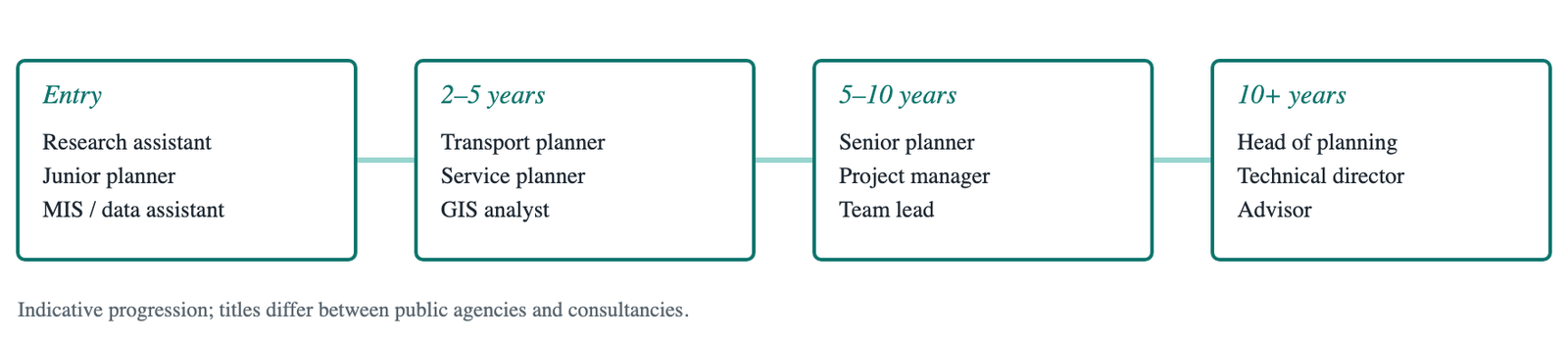
Entry (0–2 years)
Research assistant, junior planner or data assistant. You’ll clean data, run surveys, draw maps and draft sections of reports. The fastest learners are the ones who ask why each number matters.
Planner (2–5 years)
You own analyses end to end: a route restructuring, a timetable revision, a monthly performance review. Strong data skills are what separate planners here — see the skills for working with bus ticket data.
Senior and lead (5+ years)
Project manager, senior planner or team lead: you scope studies, manage clients or departments, and present recommendations to commissioners and boards.
Qualifications that help
- A bachelor’s in planning, architecture or civil engineering is the usual starting point.
- A master’s in transport planning or urban planning makes progression easier, especially in consultancy.
- Data roles also hire from statistics, economics and computer science — if you learn the transport basics.
- Short courses in GIS, transport modelling and Python or SQL add a lot for little time.
Getting your first role
- Build two or three small projects. A route performance note from a public timetable, a stop catchment map, a cleaned-up messy dataset with notes on what you fixed.
- Lead your CV with outcomes. What you found and what changed because of it, not a list of software.
- Expect a technical round. Most interviews test bus performance indicators — prepare with our transit KPI interview questions and answers.
- Read each notice carefully. Public-sector posts can have specific eligibility rules; consultancy roles often mean travel to project cities.
FAQ
Is public transport planning a good long-term career in India?
Demand is growing with city bus fleet expansion, metro projects and the push for data-driven service planning, and the skills transfer between public agencies, consultancies and technology firms.
Can architects move into transport planning?
Yes. Many transport planners started in architecture and added a planning master’s or targeted courses in GIS and data analysis.