
The Bihar Public Service Commission (BPSC) has officially released Advertisement No. 89/2025 for recruitment to the post of Assistant Town Planner (ATP) under the Urban Development and Housing Department, Government of Bihar. This comprehensive guide covers everything candidates need to know, including 35 vacancies across reserved and unreserved categories, detailed eligibility criteria, examination structure, salary details, and previous year question papers to aid your preparation.
Table of Contents
Recruitment Overview & Quick Facts
Quick Information Table
| Parameter | Details |
|---|---|
| Recruiting Body | Bihar Public Service Commission (BPSC) |
| Department | Urban Development and Housing Department, Government of Bihar |
| Post Name | Assistant Town Planner (ATP) |
| Advertisement Number | 89/2025 |
| Total Vacancies | 35 Posts |
| Job Location | Bihar State (Multiple Cities/Districts) |
| Job Type | State Government Permanent Position |
| Pay Level | Level-9 (7th Pay Commission) |
| Estimated Monthly Salary | ₹70,000–₹80,000 (including allowances) |
| Application Mode | Online |
| Application Start Date | 28 August 2025 |
| Application Deadline | 22 September 2025 (11:59 PM) |
| Exam Date | Postponed (Earlier tentative was 30 January 2026) |
| Official Website | bpsc.bihar.gov.in |
| Application Fee | ₹100/- (for all categories) |
Category-Wise Vacancy Distribution
Total Vacancies Breakdown
The BPSC has announced a total of 35 vacancies distributed across various reserved and unreserved categories as follows:
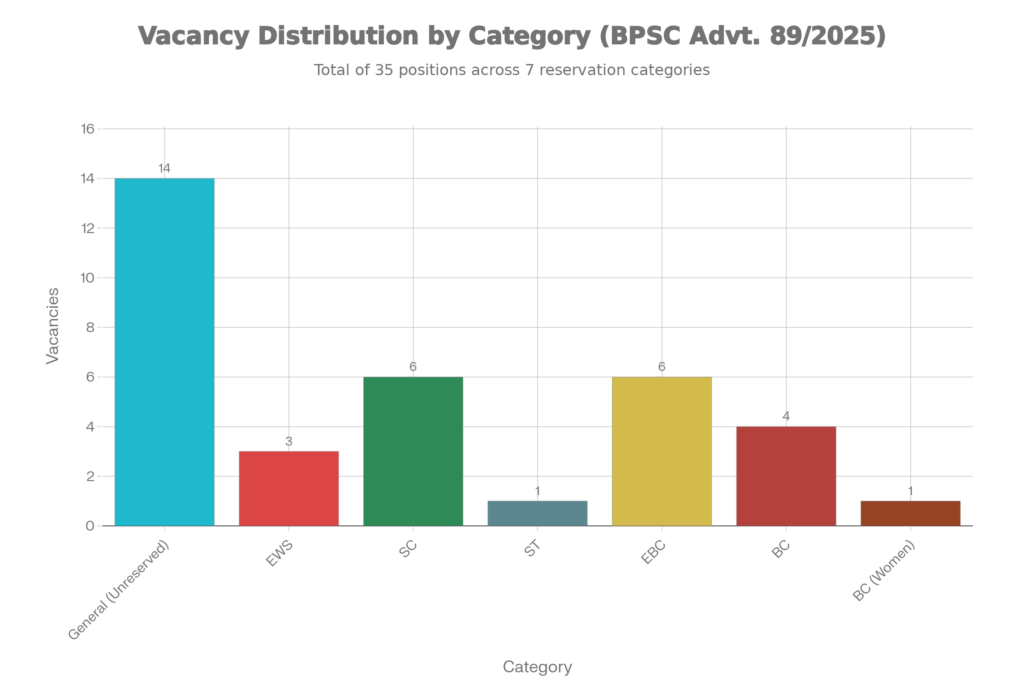
Detailed Category-Wise Vacancy Table:
| Category | Total Vacancies | Percentage |
|---|---|---|
| General (Unreserved) | 14 | 40% |
| Economically Weaker Section (EWS) | 3 | 8.6% |
| Scheduled Caste (SC) | 6 | 17.1% |
| Scheduled Tribe (ST) | 1 | 2.9% |
| Extremely Backward Class (EBC) | 6 | 17.1% |
| Backward Class (BC) | 4 | 11.4% |
| Backward Class (Women) | 1 | 2.9% |
| Total | 35 | 100% |
Key Points:
- The largest share of vacancies (40%) is reserved for General (unreserved) candidates
- Scheduled Caste (SC) and Extremely Backward Class (EBC) each account for 17.1% of vacancies
- One vacancy is specifically reserved for Backward Class women candidates
- This distribution ensures opportunities for diverse candidate backgrounds
Eligibility Criteria
Age Limit Requirements
Minimum Age Limit (as on 01-08-2025):
- Minimum Age: 21 years (for all categories)
Maximum Age Limit (as on 01-08-2025):
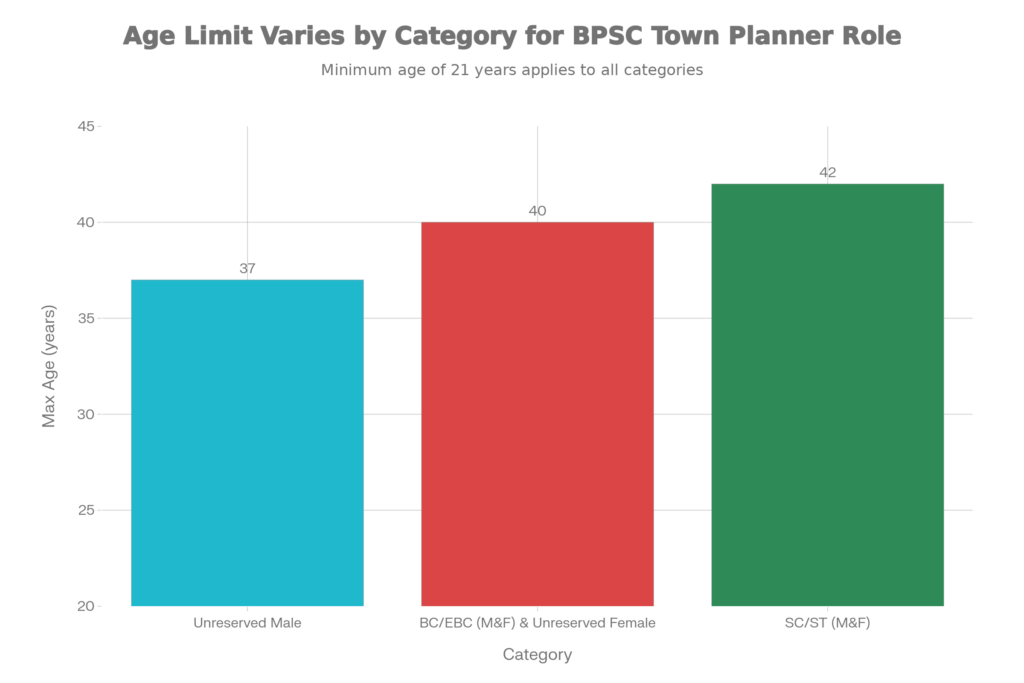
Detailed Age Limit Table:
| Category | Minimum Age | Maximum Age | Age Range |
|---|---|---|---|
| General (Unreserved) – Male | 21 years | 37 years | 16 years |
| General (Unreserved) – Female | 21 years | 40 years | 19 years |
| Backward Class (BC) – Male & Female | 21 years | 40 years | 19 years |
| Extremely Backward Class (EBC) – Male & Female | 21 years | 40 years | 19 years |
| Scheduled Caste (SC) – Male & Female | 21 years | 42 years | 21 years |
| Scheduled Tribe (ST) – Male & Female | 21 years | 42 years | 21 years |
Important Notes:
- Age relaxation is provided to backward and marginalized categories
- Female candidates in general category get 3 years additional relaxation (40 years instead of 37 years)
- SC/ST candidates get maximum relaxation with age limit up to 42 years
- Age is calculated as on 01 August 2025
Educational Qualification Requirements
Candidates applying for the BPSC Assistant Town Planner position must possess one of the following Post Graduate Degrees from a recognized university or institution:
Eligible PG Qualifications:
- Post Graduate Degree (or equivalent) in Town Planning
- Post Graduate Degree (or equivalent) in Urban Planning
- Post Graduate Degree (or equivalent) in Regional Planning
- Post Graduate Degree (or equivalent) in City Planning
- Post Graduate Degree (or equivalent) in Country Planning
- Post Graduate Degree (or equivalent) in Transport Planning
- Post Graduate Degree (or equivalent) in Housing
- Post Graduate Degree (or equivalent) in Environmental Planning
Key Points:
- Minimum qualification is Post Graduate (Master’s level) degree
- Bachelor’s degree is NOT sufficient for this position
- The degree must be from a recognized university or institution
- Equivalent qualifications in the above fields are also acceptable
- Professional certifications must be recognized by the concerned authority
Job Profile & Responsibilities
What Does an Assistant Town Planner Do?
The role of an Assistant Town Planner is a technical and administrative hybrid position that plays a crucial role in urban development. Key responsibilities include:
Primary Responsibilities:
- Master Plan Development: Assist in preparing and implementing master development plans and detailed project reports for cities and towns across Bihar
- Land-Use Planning: Demarcate and plan residential, commercial, industrial, and public service zones to ensure optimal urban utilization
- Infrastructure Planning: Plan and coordinate housing projects, road networks, drainage systems, water supply, public utilities, and transportation systems
- Building Plan Approvals: Review and approve building plans, layouts, and design specifications submitted by developers and property owners
- Compliance & Verification: Verify layout plans, conduct site inspections, and ensure compliance with building bye-laws and zoning regulations
- Public Services Coordination: Work with local bodies (Municipal Corporations, Nagar Palikas) to support infrastructure implementation
- Environmental Planning: Consider environmental impact assessments and sustainable development principles in all planning initiatives
- Record Maintenance: Maintain accurate records of approved plans, surveys, and project progress
Developmental Impact:
- Direct involvement in Bihar’s urban growth and sustainable urbanization process
- Contributing to improved quality of life for urban residents through planned infrastructure
Selection Process & Examination Pattern
Selection Stages
The selection process for BPSC Assistant Town Planner consists of the following stages:
| Stage | Details |
|---|---|
| Stage 1 | Written Examination (Objective Type) |
| Stage 2 | Document Verification & Merit List Preparation |
| Stage 3 | (If applicable) Interview and Final Selection |
Written Examination Pattern
Exam Structure:
| Parameter | Details |
|---|---|
| Total Papers | 1 Paper (Single Technical Paper) |
| Paper Name | Town Planning |
| Question Type | Objective Multiple Choice Questions (MCQs) |
| Total Questions | 125 Questions |
| Maximum Marks | 125 Marks |
| Exam Duration | 2 Hours |
| Marking Scheme | 1 mark per correct answer |
| Negative Marking | NO negative marking for incorrect answers |
| Exam Mode | Computer-Based Test (Online) |
Key Advantages:
- No negative marking – candidates can attempt all questions without fear of penalty
- Single paper – focused on technical knowledge of town planning
- 2-hour duration – sufficient time to answer all questions
Qualifying Marks (Minimum Cut-off)
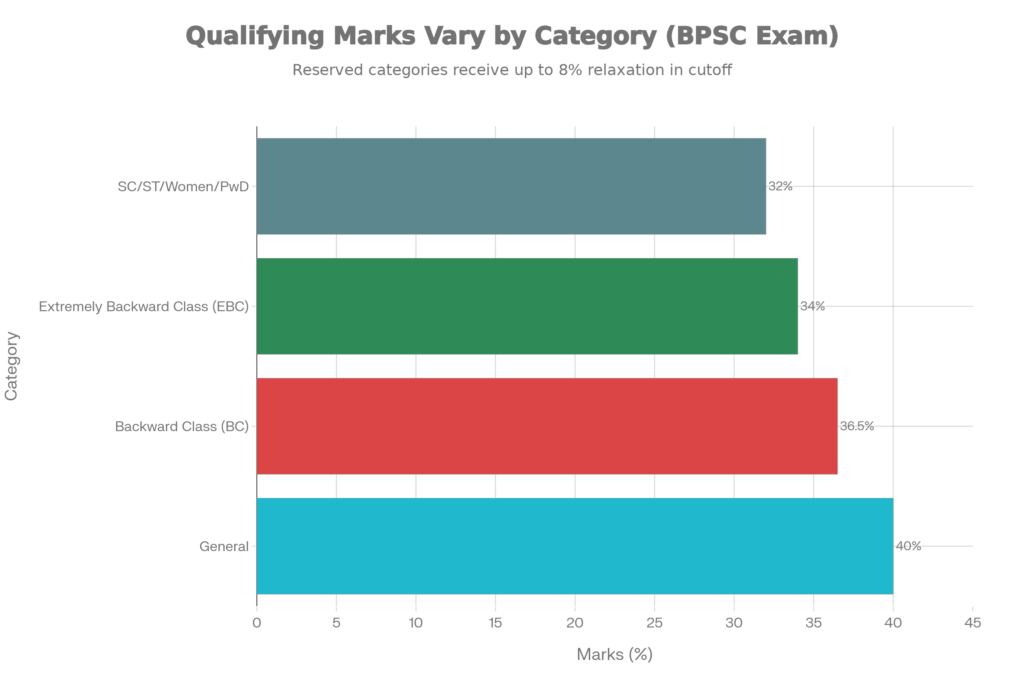
Detailed Minimum Qualifying Marks Table:
| Category | Minimum Qualifying Marks (in %) | Marks Out of 125 |
|---|---|---|
| General (Unreserved) | 40% | 50 marks |
| Backward Class (BC) | 36.5% | ~45-46 marks |
| Extremely Backward Class (EBC) | 34% | ~42-43 marks |
| Scheduled Caste (SC) | 32% | ~40 marks |
| Scheduled Tribe (ST) | 32% | ~40 marks |
| Women Candidates | 32% | ~40 marks |
| Persons with Disabilities (PwD) | 32% | ~40 marks |
Important Notes:
- Candidates must secure minimum qualifying marks to be considered for further stages
- Different qualifying marks exist for different categories
- Reserved categories have lower qualifying marks as per government guidelines
Syllabus & Examination Topics
Comprehensive Exam Syllabus
The BPSC Assistant Town Planner exam (Town Planning Paper) tests candidates’ knowledge across diverse topics related to urban and town planning. Here’s the detailed syllabus breakdown:
Town Planning Syllabus Topics:
1. Urban & Regional Planning Fundamentals
- Concepts and principles of urban planning
- Regional planning methodologies
- Sustainable urbanization
- New Town Development concepts
- Metropolitan area planning
- Urban growth patterns and dynamics
2. Planning Techniques & Methodology
- Master Plan preparation and components
- Development plan formulation
- Strategic planning approaches
- Participatory planning methods
- GIS and remote sensing in planning
- Urban design principles
3. Land-Use Planning
- Classification of land uses (Residential, Commercial, Industrial, Agricultural)
- Zoning regulations and zoning by-laws
- Land acquisition and utilization
- Industrial location planning
- Agricultural land preservation
4. Housing & Infrastructure Planning
- Housing needs assessment and demand analysis
- Public and private housing development
- Slum development and rehabilitation
- Infrastructure planning (Water supply, Sewerage, Electricity, Telecom)
- Waste management planning
- Smart city infrastructure
5. Transportation Planning
- Urban transportation systems
- Road network planning and design
- Public transport systems (Bus, Metro, Rail)
- Traffic management and congestion mitigation
- Parking management
- Pedestrian and cycling infrastructure
6. Building Bye-Laws & Regulations
- National Building Code (NBC) requirements
- State Building Bye-Laws
- Building approval procedures
- Setbacks and density regulations
- Safety standards and fire regulations
- Accessibility standards for persons with disabilities
7. Environmental & Sustainable Planning
- Environmental impact assessment
- Climate change adaptation in urban areas
- Green spaces and urban forestry
- Water resource management
- Energy efficiency in buildings
- Pollution control and mitigation
8. Urban Governance & Policies
- Municipal administration structure
- Urban local bodies (ULBs) functions
- Town and Country Planning Act (State level)
- Housing policies and guidelines
- Central government housing schemes (Pradhan Mantri Awas Yojana, etc.)
- Urban development policies
9. Financial Planning for Urban Development
- Municipal revenue and budget allocation
- Cost estimation and project budgeting
- PPP (Public-Private Partnership) models
- Development charges and betterment levy
- Financial management of urban projects
10. Demographic & Social Planning
- Population analysis and projection
- Social infrastructure planning (Schools, Hospitals, Parks)
- Community development
- Gender-sensitive planning
- Inclusive urban planning
11. Special Planning Areas
- Heritage area conservation
- Industrial estate planning
- Commercial district development
- Tourism zone planning
- Religious/cultural precinct planning
12. Planning Laws & Standards
- Minimum standards for urban development
- Residential density standards
- Open space requirements
- Parking standards
- Minimum distance separation norms
Preparation Strategy Tip: Focus on understanding practical applications of planning concepts as BPSC emphasizes real-world urban development scenarios rather than theoretical knowledge alone.
Previous Year Question Papers & Exam Insights
Understanding Previous Year Questions
While the current BPSC Assistant Town Planner (Advt. 89/2025) is a new recruitment drive with a modified exam pattern (single technical paper instead of multiple papers), previous years’ question papers from similar BPSC planning positions provide valuable insights into:
- Question difficulty level
- Topic weightage and distribution
- Types of questions asked
- Time management requirements
- Frequently asked topics
Previous Exam Pattern Reference
For candidates seeking reference, earlier BPSC Assistant Town Planning Supervisor exams followed this pattern:
Earlier Pattern (For Reference):
| Component | Details |
|---|---|
| Paper I | General Studies – 100 marks, 125 MCQs, 2 hours |
| Paper II (Option 1) | Planning – 100 marks, 125 MCQs, 2 hours |
| Paper II (Option 2) | Remote Sensing & GIS (Specialization in Urban & Regional Studies) – 100 marks, 125 MCQs, 2 hours |
| Total Marks | 200 marks |
| Total Duration | 4 hours |
Current Pattern (Advt. 89/2025):
- Single Technical Paper on Town Planning only
- 125 MCQs, 125 marks, 2 hours duration
- No General Studies paper in current recruitment
Sample Question Topics from Previous Papers
Based on previous year question papers from similar BPSC planning exams, expect questions in these areas:
High Weightage Topics:
- Urban planning definitions and concepts
- Master plan components and preparation
- Land-use classification and zoning
- Building bye-laws and regulations
- Housing and infrastructure planning
- Transportation network design
- Environmental considerations in planning
- Municipal administration and governance
- National Planning policies and schemes
Medium Weightage Topics:
- GIS and remote sensing applications
- Sustainability and green planning
- Social infrastructure planning
- Financial planning for urban projects
- Heritage conservation
Lower Weightage Topics:
- Advanced technical computations
- International case studies
- Theoretical frameworks
Types of Questions in Previous Papers
Candidates should expect:
- Definitional Questions: “Define master plan,” “What is zoning?”
- Conceptual Questions: “What are the principles of sustainable urban development?”
- Practical Application: “How would you approach housing shortage in a city?”
- Policy & Regulatory: “As per NBC, what is the minimum open space requirement?”
- Calculation-Based: Distance ratios, density calculations, area conversions
- Matching Questions: Matching planning concepts with definitions or examples
- Multiple Scenario Analysis: Which planning approach is best for X situation?
Download Previous year question paper
Exam Analysis Tips
From Previous Examinations:
- Average time per question: 57 seconds (2 hours ÷ 125 questions)
- Recommended strategy: Attempt easier questions first, then tackle complex ones
- Success rate: Candidates scoring 45+ marks generally qualify in written exam
- Merit list is prepared strictly based on written exam marks
- Cutoff marks vary annually based on:
- Total number of qualified candidates
- Difficulty level of the paper
- Category-specific performance
Salary Structure & Benefits
Pay Scale & Monthly Salary
Pay Level & Designation:
| Parameter | Details |
|---|---|
| Pay Level | Level-9 (7th Pay Commission) |
| Base Salary (Approx.) | ₹55,000–₹60,000 |
| Dearness Allowance (DA) | ~15,000–₹18,000 (varies as per government notification) |
| House Rent Allowance (HRA) | Varies by posting location (8-30% of basic pay) |
| **Total Monthly Salary (Approx.) | ₹70,000–₹80,000+ |
Benefits & Allowances:
- Dearness Allowance (DA): Increases annually with inflation
- House Rent Allowance (HRA): Based on city classification (Class A, B, C)
- Transport Allowance: ₹3,200–₹5,400 (as per 7th Pay Commission)
- Furniture Allowance: Limited allowance for office setup
- Leave Travel Allowance (LTA): For travel within India
- Gratuity: ₹10 lakhs or one month salary × years of service (whichever is higher)
- Pension Benefits: Defined Benefit Pension (DBP) scheme
- CGHS/BGSHS: Cashless health insurance for family
- Life Insurance: Group Life Insurance coverage
- Accident & Disability Benefits: As per government policy
Career Growth & Advancement
- Promotion Path: Assistant Town Planner → Senior Town Planner → Town Planning Officer → Deputy Director/Director
- Superannuation Age: 60 years
- Career prospects: Significant scope for advancement to senior positions within Urban Development Department
- Transfer: Potential postings across various districts and cities in Bihar
Application Process – Step-by-Step Guide
Important Dates (Already Closed)
| Event | Date |
|---|---|
| Application Start Date | 28 August 2025 |
| Application Deadline | 22 September 2025 (11:59 PM) |
| Exam Date | Postponed (Earlier tentative was 30 January 2026) |
| Admit Card Release | A few days before exam |
| Result Declaration | To be announced |
Note: The application window has closed. This guide is for reference and future recruitment cycles.
How to Apply (Process Steps)
For Future Recruitments or Reference:
- Visit Official Website: Go to https://bpsconline.bihar.gov.in or bpsc.bihar.gov.in
- Complete One-Time Registration (OTR):
- Provide valid email ID and mobile number
- Create secure password
- Verify email and mobile OTP
- Receive login credentials
- Login to Application Portal:
- Use email ID and password
- Complete your profile in 6 steps:
- Personal Information (Name, DOB, Father’s name)
- Address Details (Permanent and Current)
- Other Details (Nationality, Religion, Category)
- Qualification Information (Degree, University, Year)
- Experience Details (if applicable)
- Upload photo and signature
- Apply for the Position:
- Select “Assistant Town Planner (Advt. 89/2025)”
- Fill required details as per notification
- Review all entered information carefully
- Declare that information is true and accurate
- Upload Supporting Documents:
- Scanned photograph (4.5 cm × 3.5 cm) in JPG/PDF format
- Scanned signature in JPG/PDF format
- Educational certificates (PDF format)
- Caste certificate (if applicable)
- PwD certificate (if applicable)
- NOC from current employer (if employed)
- Pay Application Fee:
- Fee: ₹100/- for all categories
- Payment mode: Online (Net Banking, Debit Card, Credit Card)
- No refund of application fee
- Submit Application:
- Review all details one final time
- Click “Submit” button
- Download and Print confirmation page with registration number
- Save PDF for future reference
Required Documents
Essential Documents to Prepare Before Applying:
- Photograph: Recent, 4.5 cm × 3.5 cm, passport-size, color, on white background
- Signature: Clear scanned signature
- Educational Certificates:
- Bachelor’s degree certificate
- Master’s/Post Graduate degree certificate
- All intermediate certificates
- Diplomas (if applicable)
- Identity Proofs (Any 2):
- Aadhar Card
- PAN Card
- Voter ID
- Passport
- Driving License
- Category Certificate:
- SC/ST certificate (from SDM)
- OBC/EBC certificate (if applicable)
- EWS certificate (if applicable)
- PwD Certificate: If applicable (from authorized medical board)
- NOC: If currently employed in government/semi-government organization
- Caste Validity Certificate: If changing caste/category
10. Preparation Strategy & Study Tips
Comprehensive Preparation Strategy
Phase 1: Foundation Building (Weeks 1-4)
- Study basic concepts of urban and regional planning
- Understand master plan structure and components
- Learn land-use classification and zoning principles
- Read national and state building codes basics
Phase 2: Core Topics (Weeks 5-12)
- Study detailed syllabus systematically by topic
- Focus on: Infrastructure planning, housing, transportation, environmental planning
- Learn current urban development policies and schemes
- Understand regulations and bye-laws
Phase 3: Application & Problem-Solving (Weeks 13-16)
- Practice scenario-based questions
- Solve previous year papers repeatedly
- Time yourself while solving papers
- Identify weak areas and revise
Phase 4: Final Revision (Weeks 17-20)
- Create summary notes for each topic
- Solve full-length mock tests
- Focus on areas with highest weightage
- Revise important definitions and regulations
Recommended Study Resources
Books:
- Urban and Regional Planning by P. Agarwal
- Town Planning (Town & Country Planning Act) – State-specific materials
- Building Bye-Laws – State of Bihar publication
- Infrastructure Planning in India – Standard academic texts
- Environmental Planning and Management – Relevant state/national publications
Online Resources:
- BPSC official website for notifications and syllabus
- Previous year question papers (download from official sources only)
- YouTube channels focused on BPSC planning exams
- Online test series from recognized coaching platforms
Government Publications:
- National Building Code (NBC) – Relevant chapters
- Ministry of Urban Development guidelines
- Bihar Urban Development Policy documents
- Housing and Urban Development Corporation (HUDCO) resources
Time Management Strategy
For 125 Questions in 2 Hours:
- Average time per question: 57 seconds
- Allocate time as follows:
- 40% time on easy/direct questions (straightforward conceptual questions)
- 35% time on medium difficulty questions (require some analysis)
- 25% time on difficult/calculation-based questions (require detailed work)
Optimal Approach:
- Read the question carefully
- Attempt if answer is clear within 30 seconds
- Mark if uncertain and come back later
- Avoid getting stuck on any single question
Key Takeaways & Preparation Checklist
Essential Checklist Before Applying (For Future Recruitments)
- ✅ Verify that you meet all eligibility criteria (Age & Education)
- ✅ Ensure your Post Graduate degree is from a recognized institution
- ✅ Arrange all required documents (Certificate copies, Photo, Signature)
- ✅ Have valid email ID and mobile number for registration
- ✅ Arrange payment method for application fee (₹100)
- ✅ Check application deadline and submit well before closing time
- ✅ Download and save confirmation page with registration number
- ✅ Keep printout of application for reference
Preparation Checklist
- ✅ Complete syllabus study (All 12 topic areas)
- ✅ Solve at least 5 previous year papers multiple times
- ✅ Attempt at least 10 full-length mock tests
- ✅ Create summary notes for quick revision
- ✅ Practice time management (57 seconds per question)
- ✅ Focus on high-weightage topics (Planning techniques, regulations, infrastructure)
- ✅ Understand current government policies and schemes
- ✅ Study recent amendments in Building Bye-Laws
- ✅ Practice with online mock test series
- ✅ Revise continuously until exam date
Success Indicators
You’re ready for the exam if you can:
- Explain master plan components without reference
- Define zoning and land-use classification clearly
- Discuss building bye-laws relevant to Bihar
- Solve scenario-based planning problems
- Understand and apply GIS concepts in planning
- Discuss current housing and urban development policies
- Solve previous papers scoring 50+ marks consistently
Conclusion
The BPSC Assistant Town Planner recruitment (Advt. 89/2025) presents an exceptional opportunity for post-graduate professionals in urban planning, regional planning, or related disciplines to build a meaningful career in Bihar’s urban development sector. With 35 well-distributed vacancies across various categories, reasonable eligibility criteria, and an attractive salary package at Pay Level-9, this position offers both job security and growth potential.
Key Success Factors:
- Thorough understanding of the syllabus covering all 12 major topic areas
- Consistent practice with previous year papers and mock tests
- Strategic time management during the exam
- Focus on current policies and government schemes related to urban development
- Regular revision of high-weightage topics
Candidates should begin their preparation immediately by studying the recommended resources, understanding practical applications of planning concepts, and practicing timed mock tests. The exam expects practical knowledge applicable to Bihar’s urban development context rather than theoretical concepts alone.
For future recruitment cycles or more information, regularly visit bpsc.bihar.gov.in and stay updated with official notifications. Best wishes for your preparation and success in securing this prestigious government position!
FAQs
Is this a fresh recruitment or promotion from existing staff?
This is a fresh recruitment drive by BPSC. Both new candidates and existing government employees (with requisite qualifications) can apply. Currently employed candidates must provide NOC from their employer.
Can candidates from other states apply?
Yes, there’s no domicile restriction mentioned in the notification. However, after appointment, successful candidates will be posted in Bihar.
What is the difference between this recruitment and previous BPSC planning positions?
The current recruitment (Advt. 89/2025) follows a modified pattern with a single technical paper on Town Planning, whereas earlier recruitments had multiple papers including General Studies and optional papers. This new pattern is more focused on specialized town planning knowledge.
Is there an interview after the written exam?
The notification primarily focuses on the written examination for merit list formation. Interview details, if any, will be communicated after the written exam results.
What if my educational degree is from abroad?
Degrees from foreign universities must have equivalence recognition from AIU (Association of Indian Universities) or DEC (Distance Education Council) before applying.
Can I apply if I’m currently working in a private organization?
Yes, private employees can apply. However, you won’t need to provide NOC unless you’re employed in government/semi-government sectors.
Is there relaxation in qualification for any category?
No relaxation in educational qualification. All candidates must possess a Post Graduate degree as specified in the notification.
How is merit list prepared?
Merit list is prepared strictly based on the written examination marks. Candidates are ranked category-wise, and selections are made against available vacancies in each category.
What happens if multiple candidates score the same marks?
Tie-breaking criteria (generally date of birth or registration order) as specified in the official notification will be applied.
Can I change my answer after submission?
No. Once the online exam is submitted, answers cannot be changed. Review before final submission.
Will there be document verification before final selection?
Yes. After written exam, document verification will be conducted to verify educational qualifications, age, category certificates, and other claims made in the application.
What is the posting location after selection?
Selected candidates will be posted across various districts and cities in Bihar as per government requirement. Specific posting locations are not pre-determined.

One thought on “BPSC Assistant Town Planner (Advt. No. 89/2025) – Complete Guide: Vacancy Details, Eligibility, Exam Pattern & Previous Year Questions”